



The Journaling Nobody Taught You

Most of us learned to journal the same way, back when it started with "Dear Diary" and a recap of the day.
You'd write down what happened and how it landed, close the notebook, and feel a little lighter for having put it somewhere. That kind of writing has its place, and there's real relief in getting the day off your chest.
There's another kind, though, and it's the one that actually moves something, because it doesn't just record a feeling; it works with it. If you've been faithfully keeping a journal for months and quietly wondering why you don't feel any different, that difference is usually the reason. It isn't a matter of effort or discipline. It's simply that most of us were never taught the second kind of writing.
What Writing On Paper Actually Does, Scientifically
There's real science under this, not just the comfort of it. Expressive writing offers clarity and insight, and it gives your feelings a safe and effective way out, which is why studies have tied it to lower stress and a faster path through the things that weigh on us.
The reason is simpler than it sounds. When you feel lost, your thoughts tend to swirl, and writing them down brings a kind of order, turning vague feelings into concrete ideas you can actually understand and work with. Putting a feeling into words asks you to slow down and look at it, and often that alone, just naming the thing underneath the noise, takes some of the heat out of it. It's truly self-directed change, which is another way of saying the page doesn't do the work for you. It simply gives the work somewhere to happen.
Two Kinds Of Entries
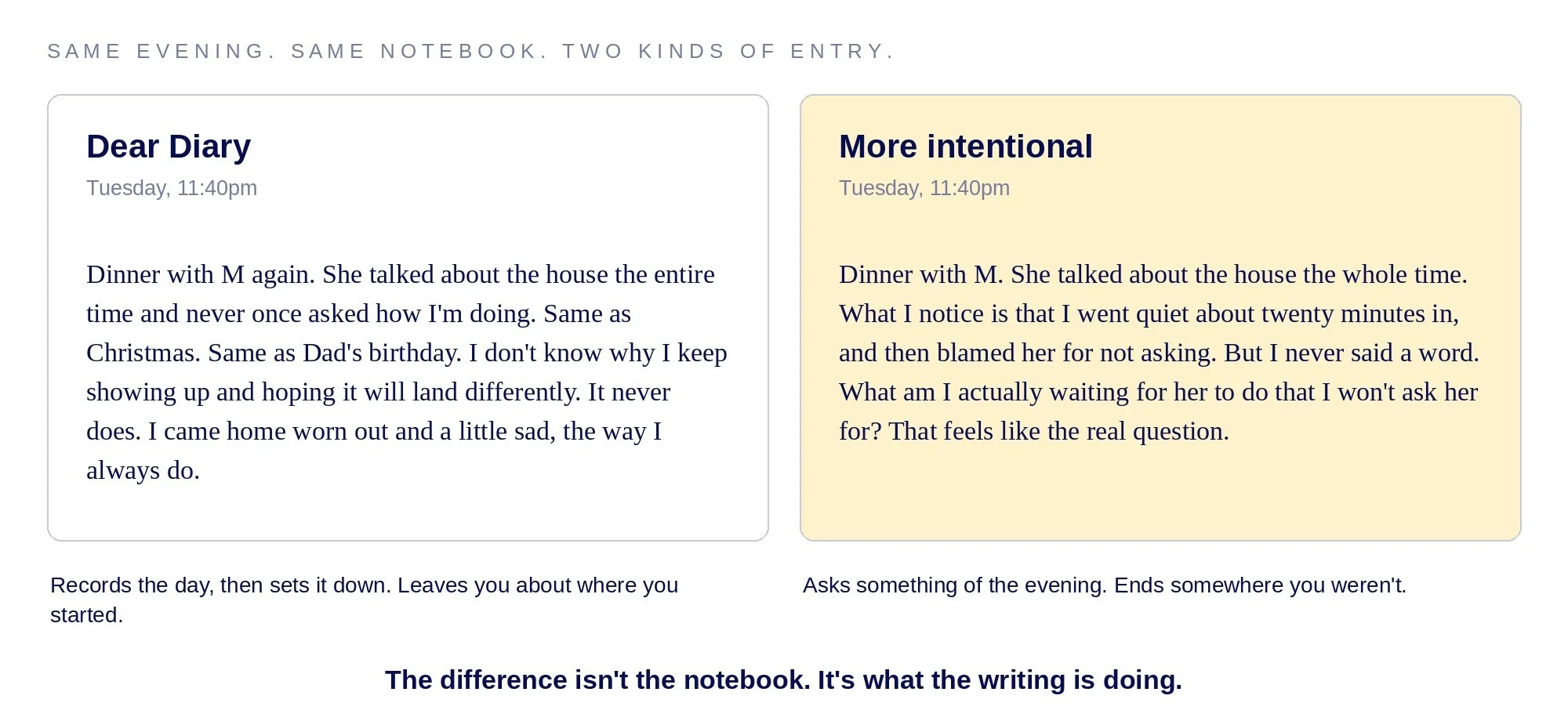
The difference between them isn't the notebook, and it isn't how long you sit there. It's what the writing is actually doing.
A Dear Diary entry records. It tells the story of the day and how it felt, and then it sets the day down, which is genuinely useful for getting things out, even if it tends to leave you about where you started. A more intentional entry takes that same evening, that same knot in your chest, and asks something of it instead. What did this mean? What shifted? Why does this keep landing the same way? Somewhere in the asking, the thing usually loosens into something you can look at directly.
That small move, from recording a feeling to working with it, is most of what separates journaling that helps from journaling that quietly keeps you circling the same ground.
A Few Things To Try On Your Own
You don't need anything but a pen to start moving from one kind to the other.
Ask one more question: After you've written what happened and how you feel, don't close the notebook yet. Add a line: What does this mean, or what do I keep learning here? That single extra question is often the whole difference.
Give it a gentle edge: Set a soft time limit. Circling expands to fill whatever space you hand it, and a loose twenty minutes tends to stay more honest than an open-ended hour.
Notice the entry you keep avoiding: The subject you almost write about and then quietly steer around. That's usually the one worth staying with.
None of this requires a class or a therapist. Plenty of people find their own way to the intentional kind, and if that's you, wonderful.
If You'd Like To Learn It Properly
Some things are easier to learn in a room, with someone showing you how and other people doing it alongside you.
Barbie teaches a journaling class for exactly that. It walks through the difference between a Dear Diary entry and one that's more intentional and more poignant, and how getting things down on paper actually affects you. It's built to be genuinely welcoming, whatever your starting point.
In her words: " If you're an old pro at therapeutic journaling, join her; she'd love to have you. If you're a novice, join her; she'd love to have you. And if the last entry you wrote was "Dear Diary" back in third grade, join her; she'd love to have you.
Get more information on the class here.
Frequently Asked Questions About Journaling
Can journaling make you feel worse?
It can, more often than people expect. Writing that circles the same hurt without ever asking anything of it tends to deepen the groove rather than ease it. The writing isn't the problem. It's what the writing is doing, and that part can change.
What makes journaling "therapeutic" rather than just a diary?
Mostly intention. A diary records the day. Therapeutic journaling takes the same day and asks something of it: what it meant, what shifted, what it keeps trying to tell you. That small turn is most of the difference.
Do I have to write every day for it to work?
Not at all. Frequency matters far less than people think, and a nightly habit that's become a chore is often worth loosening rather than forcing. One honest, intentional entry does more than seven dutiful ones.
Do I need a therapist in Houston to journal?
No, and plenty of people find their own way to the intentional kind. You might want a class or a therapist if you've been writing about the same thing for a while and it isn't shifting, since that usually means you're circling something that's hard to see on your own.
Is journaling a substitute for therapy?
It's a companion to it, not a replacement. Writing gives your thoughts somewhere to land between sessions, and it can do real work on its own, but it isn't the same as having someone in the room noticing what you can't.