



First-Time Therapy Guide
You've been thinking about this for a while. Months, maybe. And every time you get close, something stops you, and it isn't the thing people assume.
It isn't fear of the couch. It's the not-knowing. What does this cost, really? What happens if you get in there and hate the person? What if you cry? What if you don't cry and feel like a fraud? What if you sit down and can't think of a single thing to say, and the whole expensive hour just sits there?
Nobody puts that on their website. They tell you it's normal to feel nervous, which is true and useless, and then they skip straight to the part where you book.
So here's the other version. Everything nobody tells you, starting with the part everybody's actually thinking about.
The Awkward Question First
Money.
Nobody wants to be the person who asks what it costs. It feels like haggling over something you shouldn't haggle over. So people don't ask, and then they don't book, and they tell themselves it was about scheduling.
Nobody wants to be the one who asks. It feels like haggling over something you shouldn't haggle over. So people don't ask, don't book, and tell themselves it was about scheduling.
Let's just talk about it.
We're private pay. We don't take insurance, and we do give you a superbill.
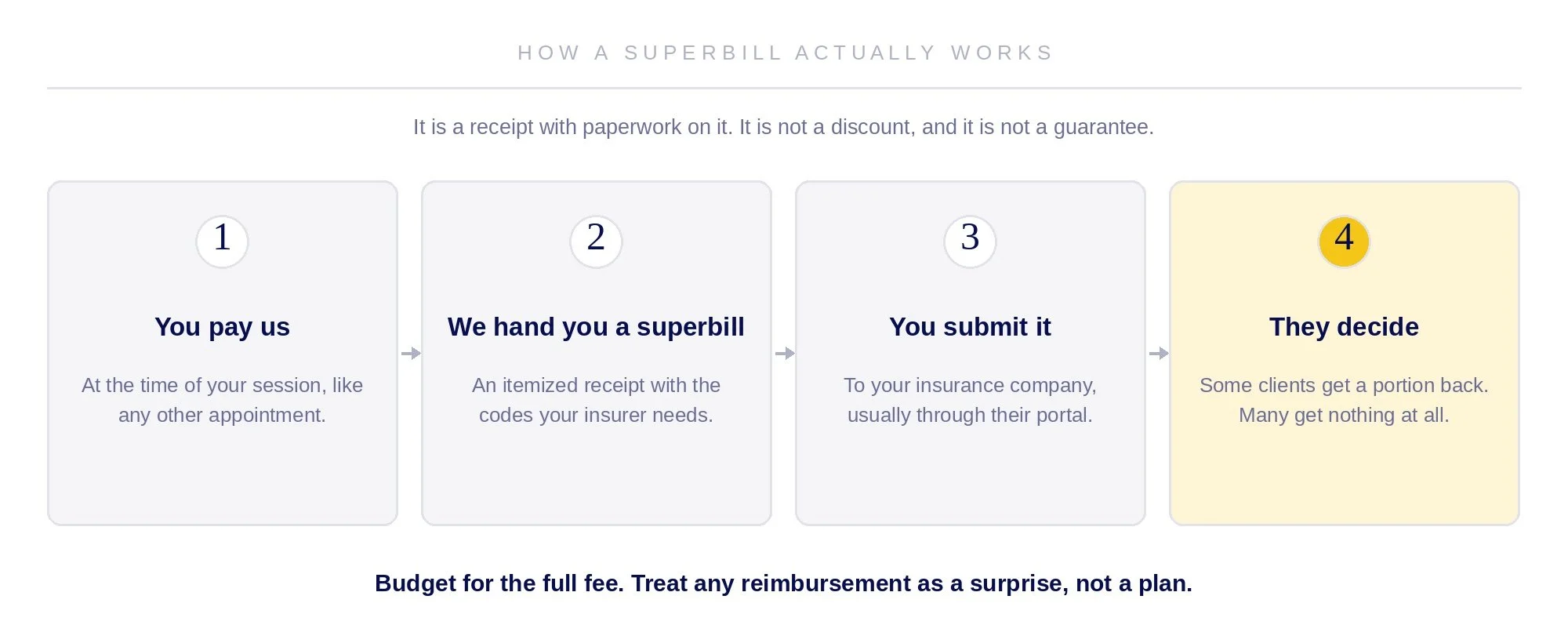
Some clients get a portion back. A lot of people get nothing. Full reimbursement is rare, so please don't build your budget around it.
If that's more than you can spend, that happens, and it's okay to say so out loud.
We have a graduate student intern. $80 for your first session, $50 after that, and she's supervised the whole way through. Same practice, same couch. There aren't many spots, but it never hurts to ask.
The First Ninety Minutes
Your first session runs ninety minutes. The ones after that are fifty.
The extra time isn't padding. There's a lot to get through the first time, and doing it in a rush means starting real work with someone who doesn't know you yet.
There's paperwork. Consent forms, privacy policies, and some questions about your history. Less than you're picturing, and nobody grades it.
Your therapist will ask what brought you in. People dread this question because they think they need a good answer. You don't. "Something's off, and I can't explain it" is enough to start with. Most people who sit down here can't explain it either, which is usually why they came.
They'll ask about the rest of it. Work, sleep, family, your relationships, what you do when things get hard. They're getting a picture of your life, not building a case.
They'll explain confidentiality, including the few situations where a therapist is legally required to break it. Those involve danger and abuse, and they're narrower than most people assume. It takes two minutes, and it's better than wondering about it for six weeks.
Nobody's going to diagnose you. A lot of practices have to, because insurance won't pay without a billing code, and a code needs a diagnosis attached. We're out of network. There's nothing to justify to anyone, so whatever's going on can just be what it is.
“What If I Don't Like Them?”
If you ever experience this, then you should say so.
Therapy only works if you can be honest in the room, and you can't be honest with someone you're quietly enduring. If it isn't clicking, that's not a failure, and it's not rudeness. It's information.
You can tell your therapist. You can ask for someone else. There are eight of us, and switching within the practice is a scheduling change, not a breakup. Nobody's feelings need managing here.
Fit isn't a personality contest, and it isn't your fault. Some pairings work, and some don't, and the good ones happen faster when nobody's being polite about it.
You're the expert on your own life. That includes being the expert on whether this particular person is right for it.
What Do I Even Say When I Reach Out?
You don't have to be articulate. You have to be reachable.
People agonize over the first email like it's a personal statement. It isn't. "I've never done this, and I don't really know where to start" is a completely normal opening line, and we get it constantly.
The next part is fifteen minutes on the phone, free, where you say roughly what's going on, and we figure out who here is the right person to talk to. You're not being screened. Nobody's deciding whether you're worthy of a session. We're just trying to make sure the person you end up with is the one who can actually help.
Then you pick a time.
We’re Ready When You Are
Nobody reads this far by accident.
You don't have to be ready today. This isn't a countdown, and there's no version of you that's too late.
When you want to, call 281-660-1351 or send us a message. Fifteen minutes, free, no forms. You say what's going on, and we figure out who you should be talking to.
That's the whole first step. It's smaller than you've been imagining it.
Common Questions About Therapy in Houston Heights
-
It varies a lot by practice and by clinician. Ours are listed on the fee page. Out-of-pocket therapy generally runs higher than an in-network copay, which is the honest tradeoff for working without an insurer in the room.
-
It's an itemized receipt with the codes your insurer needs. You submit it, and they decide. Some people get a portion back. Many get nothing. Full reimbursement is rare.
-
No. Not here. There's no billing code to justify, so there's no label anyone needs to give you.
-
Then you say that, and your therapist takes it from there. Silence isn't a problem to be solved. It's often where the useful part starts.
-
There's no threshold you have to cross. You don't have to be in crisis to deserve the hour. If it's been on your mind long enough that you're reading this page, that's usually your answer.
-
Nobody can tell you honestly, and be suspicious of anyone who tries. Some people come for a few months around a specific thing. Some stay for years. You get to decide, and you can stop whenever you want.